Assessing Fi: five ideas, and how I'd prioritise them
Fi sells a subscription with a collar attached, so keeping members comes first. Five ideas, one bet, and why.
Off the Roadmap is where I tinker with products that interest me. I pick one, assess what the business is most likely trying to achieve (from what I can glean publicly), and prototype an idea that would help. I do it for fun. I'm not affiliated with any of these companies, and I have no access to their data, their roadmap or the hundred good reasons their teams will have for doing things the way they do. It's an outside view, so tell me where I'm wrong.
"Receipt from Fi". A recent email in a Gmail folder I rarely check. Our membership had renewed. I usually miss these. I suspect Fi doesn't mind.
It took me back to the last time we debated cancelling. My wife was adamant that we needed collars with a 'lost dog mode'. I looked at the competition, found nothing that ticked all of our boxes, so we stayed. Begrudgingly. Had something better turned up, Fi would have had a double churn on its hands: two dogs, two memberships.
What is Fi you ask? From Gemini:
Fi is a smart dog collar company that makes GPS and activity-tracking collars. Often compared to an "Apple Watch for dogs", the Fi Smart Dog Collar tracks your pet's real-time location nationwide using GPS, LTE-M (via AT&T), Wi-Fi, and Bluetooth.
Why cancel? Fi's cost was originally tied up largely in the initial device purchase. You buy the collar and the ongoing cost for the tracking / data was low. They've since shifted to DaaS (Device as a Service) model. Meaning Fi now charges a recurring cost that, annually, would cover the retail price of the smart collar in itself. If you stop paying you lose several key features, including lost dog mode.
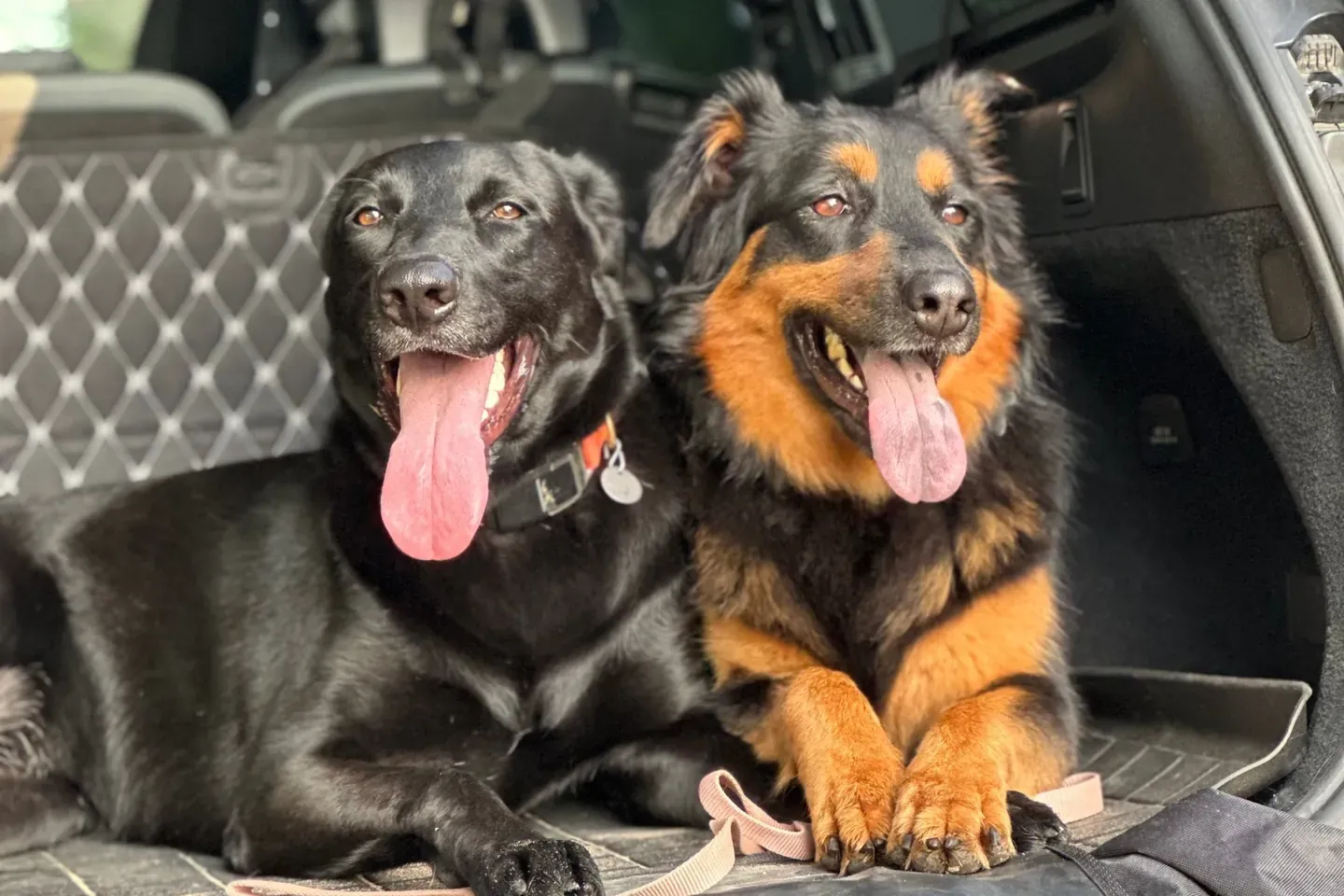
Our first pup Charlie has worn a Fi collar since early 2021, our second, Margot, since she joined us a year later. These two Texans are adventurers: hiking, swimming, and playing rough and tumble with each other constantly.
About Fi
Fi is a subscription business, plain and simple. $99 for 6-months per collar, $189 a year, or $339 for two years. Interestingly, through Wagmo, which provides pet benefits through employers, the collar comes free. A company happy to give the hardware away isn't in the hardware business.
A subscription business grows three ways: keep members, win new ones, and earn more money from each. Fi's recent launches suggest a focus on new members: a smaller tracker for small dogs and cats, a satellite version for places with no signal, and expansion to the UK and EU.
The Fi team may well sit on data that suggests otherwise, but if I were Fi I'd personally shift some (more) focus to reinforcing the 'moat'. Fi doesn't publish member numbers, but its leaderboard shows the top 100,000 dogs, so they have at least that many device subscriptions. As a ruler, not an estimate: across 100,000 members, every percentage point improvement in renewal is worth about $189,000 a year. As a long time user, I feel there's opportunity for improvement there.
What owners need, and how Fi is doing
People buy a GPS collar for two reasons: to find a lost dog, and to know it's getting enough exercise. Here's my view on how Fi is doing in some key areas.
Finding a lost dog
~ This is Fi's strength, but there's still room to grow.
It's the reason to buy a GPS collar, and Fi is built around it: escape alerts, plus a Lost Dog Mode that tracks a dog every few seconds. With adequate cellphone signal, tracking should be accurate enough to find a pup that's running around in the open. If a dog were injured, quiet, and obscured in some way (eg in deep foliage) it might not be accurate enough to find them quickly.
A personal example of this, last winter Philadelphia sat under a foot of snow and ice for about five weeks. The dogs loved it. Charlie's collar, less so: after some rough and tumble her collar came off somewhere in the park. I spent around 20 minutes looking for it in 5°F. Lost Dog Mode couldn't narrow down to a small enough area to find it in the snow. The proverbial needle in a haystack. Ironically, a stranger's dog crossed the park, caught wind of something interesting, and trotted off to sniff a patch of snow. I went straight to the spot, and there it was. Thank you pupper, you saved me a ~$100 replacement fee!
In a city, minutes matter too. On our Series 3 collars, Lost Dog Mode takes a few minutes to get going, which is a long time when a dog could be loose near busy city streets. Thankfully we haven't experienced this first hand.
Knowing how much exercise is enough
~ Fi falls short here.
Fi counts every step, tracks against a daily goal and sends a Weekly Review every Sunday. It never says whether the goal is right. Charlie's is 15,000 steps a day, set when we joined in January 2021. She's around seven now and has slowed down: this year she averages 11,059. Fi has never suggested her goal should change with her. With all the data, Fi should be able to tell me what her goal should be.
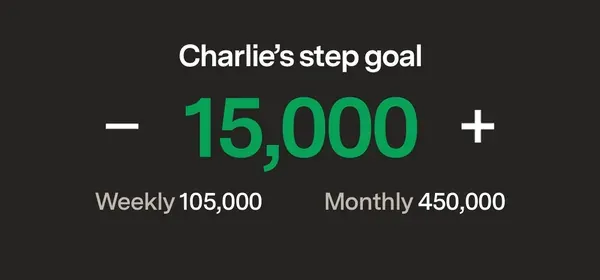
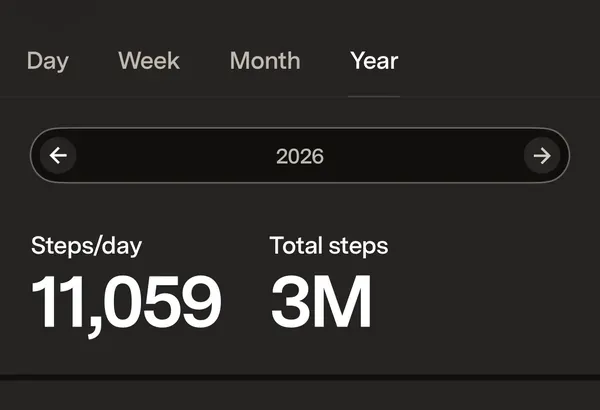
Charlie's step goal is still 15,000. Her average this year is 11,059.
Knowing the dog is all right when you're not there
~ Fi falls short here.
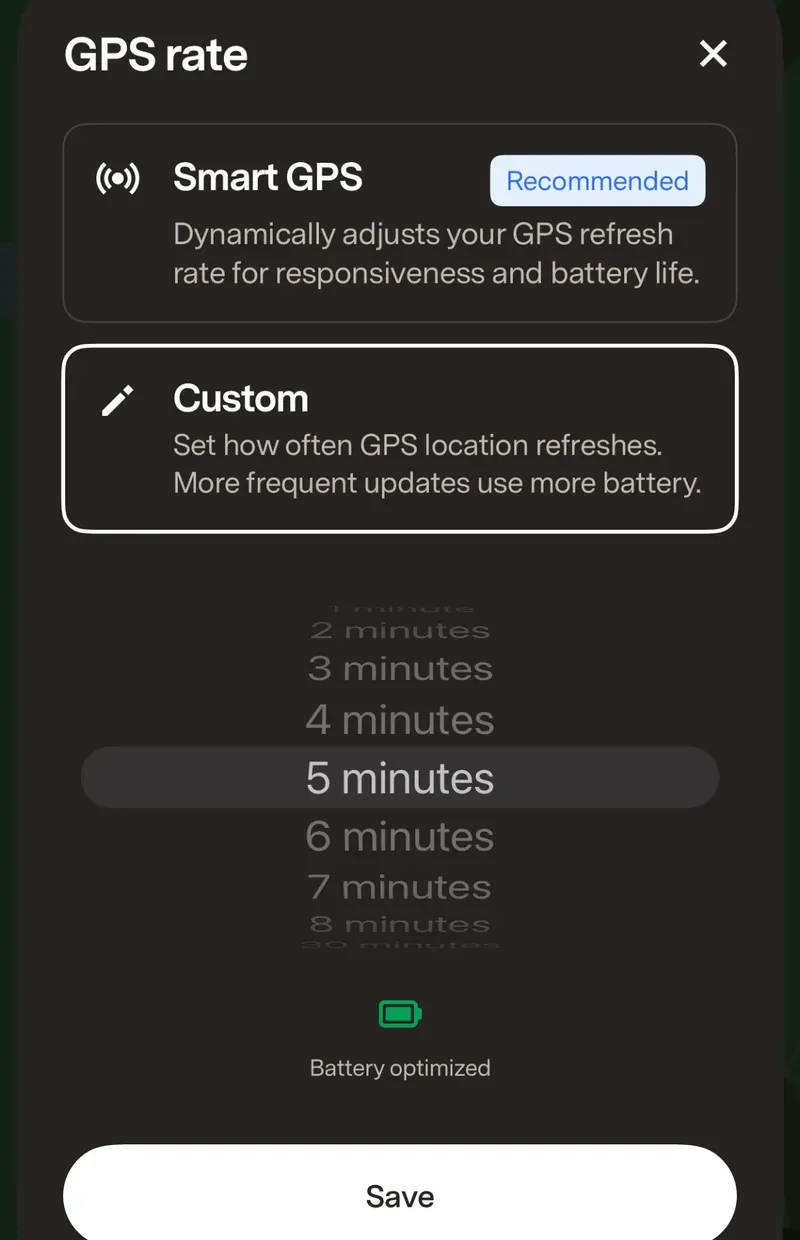
With a sitter or at a kennel, the step count is one of the few ways to truly know your dog is getting the exercise they need. Away from a connected smartphone or the Bluetooth base the battery drains fast though. In my experience, a couple days to go to zero. You can throttle the GPS to save power but it's not clear if there's a trade off. Does it still count every step? Nothing explains that clearly. A recent kennel stay suggests that Fi might not be tracking correctly - that, or I need to find another kennel... Therein lies the issue.
Finding the dog a friend / building community
~ Fi has an opportunity here.
High-energy dog owners who frequent off-leash parks love it when their pupper meets a great match and they get their zoomies out. It makes for a relaxed day ahead. But when your dog has a great play with another pup, that's often still not enough to get over the social friction of swapping numbers with a stranger in order to get the dogs together again. But Fi knows which dogs visit the same park, and there's an in-app opportunity there to help them meet again. And if Fi could crack that nut, there are community building opportunities that could follow.
Keeping owners active too
~ Not yet addressed.
A dog walk is exercise for both ends of the lead, and Fi could be missing an opportunity around encouraging owners to 'get their steps in' too. Healthier dog. Healthier human. Positive outcomes that Fi helped foster are potential fuel for improved retention.
Fi already has much of what would be needed to build in these areas: every step, every walk, every park visit. With enough scale to matter.
Here's the thing. My bet is most members are paying for peace of mind. The rankings, the lifetime step levels, and the Weekly Review suggest Fi believes owners respond to being shown raw data.
In contrast, my mantra is almost always 'less is more' when it comes to showing data to consumers.
Instead of telling me how many steps Charlie had today, tell me what I need to know, and what I could do differently. The data should be there to support that.
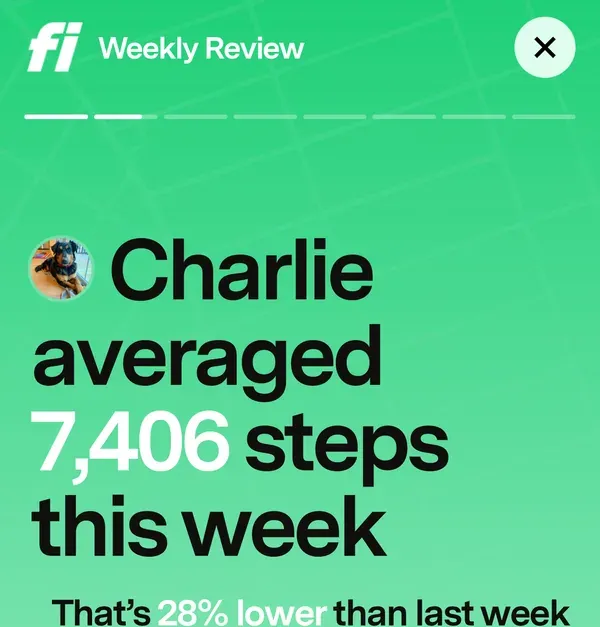
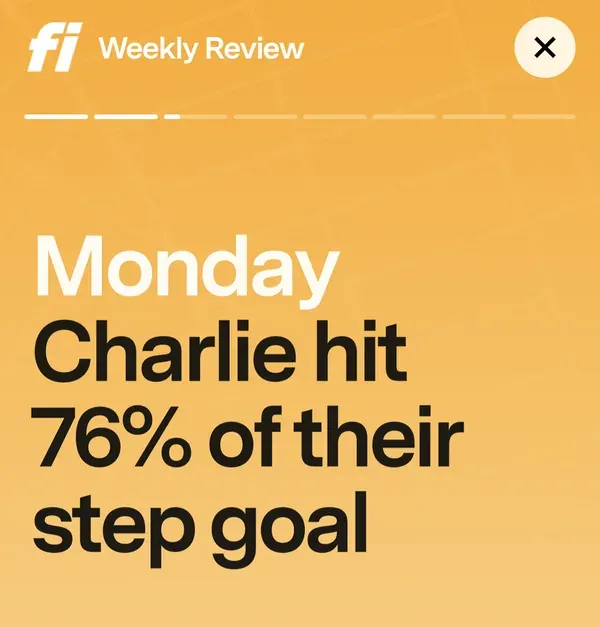
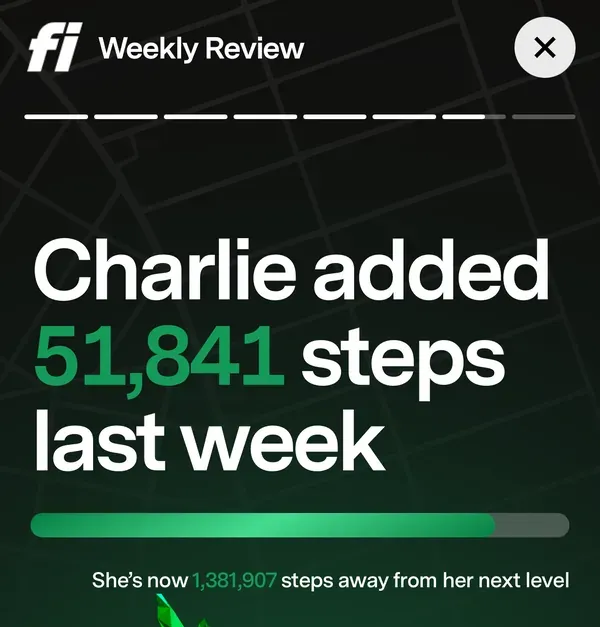
Fi's Weekly Review, from my account.
So here are five feature ideas
Three are worth taking seriously. Two hit friction fast.
1. A coach for the owner
A personal trainer for you, so you help your dog get what they need.
Fi starts by asking whether you want a goal for your dog in the first place, and leaves you alone if you don't. If you do, it learns what a good day looks like for your dog and coaches you towards more of them. Now and then, after a walk, it asks you to answer for your dog: thumbs up or down, then "too long", "not long enough" or "just right". Every six months it checks the goal still fits.
Benefits: Ongoing guidance for a loving owner, instead of a chart. More steps for the dog, a stronger case for Fi at renewal.
Feature Metrics:
- Goal set rate
- Goal hit rate
- Renewal rate
2. Owner and dog, healthier together
When a Fi walk starts, a walking workout (eg an Apple "Activity") starts on your smartphone, and it ends when you're back home. Your steps and distance sit beside the dog's, and nobody has to remember to press start. FitBark already links to Apple Health, so health integration isn't new to the category.
Benefits: a second reason to walk the dog, value for owner and dog at renewal.
Feature Metrics:
- Health app connection rate
- Human distance walked each week
- Dog distance walked each week
- Renewal rate
3. Dogs you may have met
Fi knows when two dogs keep turning up at the same park at the same time. It could let their owners connect and plan a meet-up in-app, without swapping numbers. Later opening the door to group creation, forming a 'pack'. Give it time, and the local taco place is offering deals to Fi packs, and members are inviting friends to Fi to join the pack.
Benefits: friends for the dogs and their owners, a reason to stay, new members through packs.
Feature Metrics:
- Connections
- Completed meet-ups
- Packs created
- Renewal rate
- Referral rate
4. Tests and records
Book lab tests and vaccinations at a recommended provider through the app, and keep a dog's electronic medical records centralised within Fi. Potentially discounts for owners, and referral revenue for Fi.
The catch: partnerships - national labs, and a fragmented world of vets with their own systems. There's the real friction, and it's not something I can speak to from where I sit outside the organisation.
5. Dog-walker apps
Let a walker's app (Rover's, say) talk to the collar over Bluetooth: better tracking, less battery drain, maybe a booking fee to Fi. Helps prevent zero battery events for Rover stays, and so keeps activity data, and dog sitters, honest.
The catch: it hands a third party control of a dog's collar. I'd expect that's a non-starter for Fi.
The idea I'd bet on, and why
I scored each idea on three things: how many members it reaches, how much it should move its measure, and how strong the evidence is.
| Idea | Business goal | Members it reaches | Effect on its metric | Strength of evidence | Verdict |
|---|---|---|---|---|---|
| A coach for the owner | Retention | Medium to high | Medium to high | Medium | The bet |
| Owner and dog, healthier together | Retention | Medium to high | Medium | Medium | Later, on top of the coach |
| Dogs you may have met | Retention, then referrals | Low* | Medium | Low to medium | Hold until enough dogs share a park |
| Dog-walker apps | Retention and revenue | Dropped | |||
| Tests and records | Revenue | High | High | Medium | Strong, but a partnership call |
* The least certain rating. It depends on how many Fi dogs share the same parks at the same times, which I can't see easily at scale (but Fi can).
I've assigned these scores based on analysis that uses publicly available information, without the context / data that an in-house product team would have.
Note - I am not using scoring alone to determine what I'm going to build for the Off the Roadmap series. Tests and records scores highest, but the real challenge lies in the partnerships work, so prototyping feels moot. Of the ideas a product + engineering team can ship on its own, the coach scores highest. There's also a good amount of UX to play around with in the required flows, the kind you have to see to judge.
So... the coach is my bet.
- It moves Fi's member experience from passive data dashboards and statistics to actionable guidance backed by supporting metrics.
- They could build it quickly, and relatively cheaply.
- No new hardware and no external dependencies that I see.
What the coach won't claim. That any number is good for a dog's health; from where I sit I need to assume that the evidence isn't there yet. Like a good personal trainer, the coach establishes a baseline from the owner's ongoing feedback on day to day life, and then helps motivate the owner to take positive action. Across thousands of dogs, those answers start to become the evidence.
How I'd evaluate this feature
- (pre-feature launch) Ask owners whether they want a goal at all. The share who say yes sizes the bet within days.
- (the feature experiment) Review retention amongst 3 cohorts:
- goal-setters that are being coached (our feature)
- goal-setters that we do not offer the coach (same cohort, the feature control)
- and everyone else (are goals even helpful?)
- Assess month-to-month members renewal within a quarter; annual renewals take longer.
Part 2 goes deeper into initial strategy for the coach and will include some prototyping work. Follow me on LinkedIn to catch it when it lands.
Which idea would you have backed? Tell me in the comments on the LinkedIn post, especially if it isn't the coach.